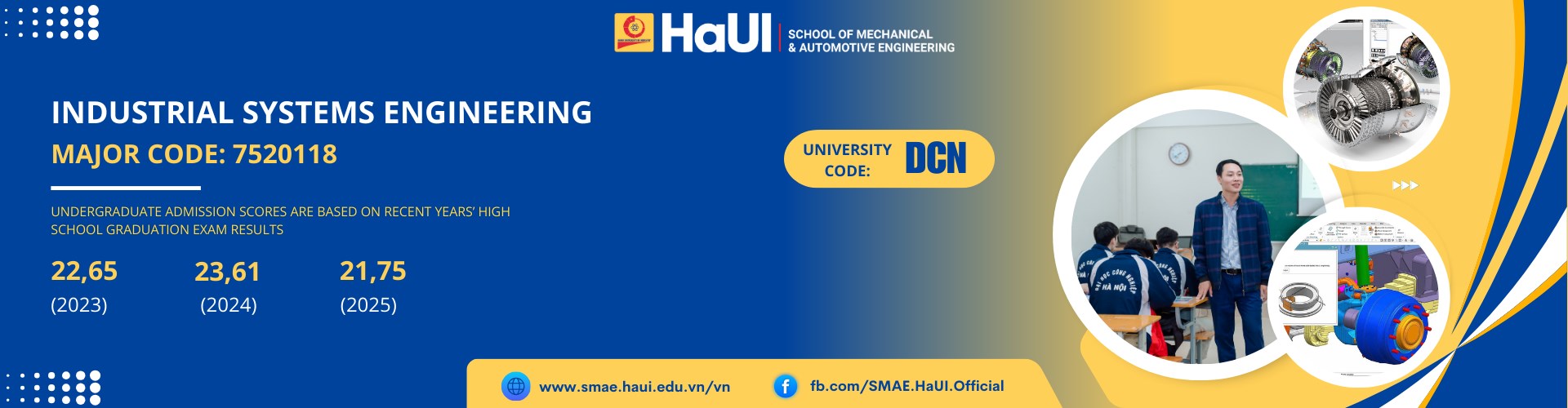
Industrial and Systems Engineering
1. General Objective
To educate and train learners with sound political and ethical qualities and good health; fundamental knowledge of social sciences, mathematics, and natural sciences; core engineering knowledge and specialized expertise in the field of Industrial Systems; the ability to perform tasks related to the design, operation, management, evaluation, and improvement of industrial systems; and the capacity to work professionally in multinational industrial environments to meet the demands of the Industrial Revolution era and contribute to society and the nation.
1. Program Education Objectives
PEO 1: Have fundamental knowledge of mathematics and basic science to acquire professional educational knowledge as well as the ability of studying at higher level.
PEO 2: Have fundamental and specialized knowledge to detect and resolve issues related to design, operation and optimization of production systems.
PEO 3: Have skills concerning individual, profession, communication and teamwork to work in multidisciplinary, multicultural and multinational work environments.
PEO 4: Have knowledge of economics and politics and fundamental knowledge in social science and humanities fields being appropriate to the training major to contribute effectively to sustainable development of society and community.
2. Student Outcomes
| SO Code | Student Outcome | PEO 1 | PEO 2 | PEO 3 |
|---|---|---|---|---|
| SO 1 | Apply the principles of engineering, science, and mathematics in professional activities. | x | ||
| SO 2 | Communicate effectively in various working environments. | x | ||
| SO 3 | Participate effectively in professional teams as both a team member and a team leader. | x | ||
| SO 4 | Apply engineering knowledge, tools, and modern technologies to solve professional problems and respond to future technological innovations and rapid technological changes. | x | ||
| SO 5 | Design and develop engineering systems, products, or processes that meet specific requirements in the field of Industrial Systems Engineering. | x | ||
| SO 6 | Develop and conduct appropriate experiments, analyze and interpret data, and use engineering judgment to draw conclusions. | x | ||
| SO 7 | Demonstrate the ability to engage in lifelong learning and recognize responsibilities towards the profession, the environment, and society. | x |
3. Career opportunities after graduation:
After graduation, bachelors majoring in Industrial and Systems Engineering have the capability to work for enterprises, production organizations or services, governmental and non-governmental organizations as well as training facilities and research institutes.
Appropriate job positions:
Students after graduation can take on jobs in the following positions:
- Materials management, supply chain and inventory planning (Materials supply such as: calculating materials needs for purchasing; Production planning and planning operations for interprises; receiving and storing goods safely and effectively; logistics such as: managing receipt and delivery to save shipping costs);
- Production workshop manager (project planning and track project schedule);
- Quality management and control (Systems analysis to improve the productivity of manufacturing line; Product inspection, operational control to ensure quality; assist in establishing and maintaining the operation of ISO 9001 quality system)
- Scheduling for production resources;
- Design production systems etc…
- Teach and research at training facilities and research institutes in Industrial Systems fields.
4. Curriculum Framework for Industrial & Systems Engineering
Copyright © 2022 School Of Mechanical And Automotive Engineering