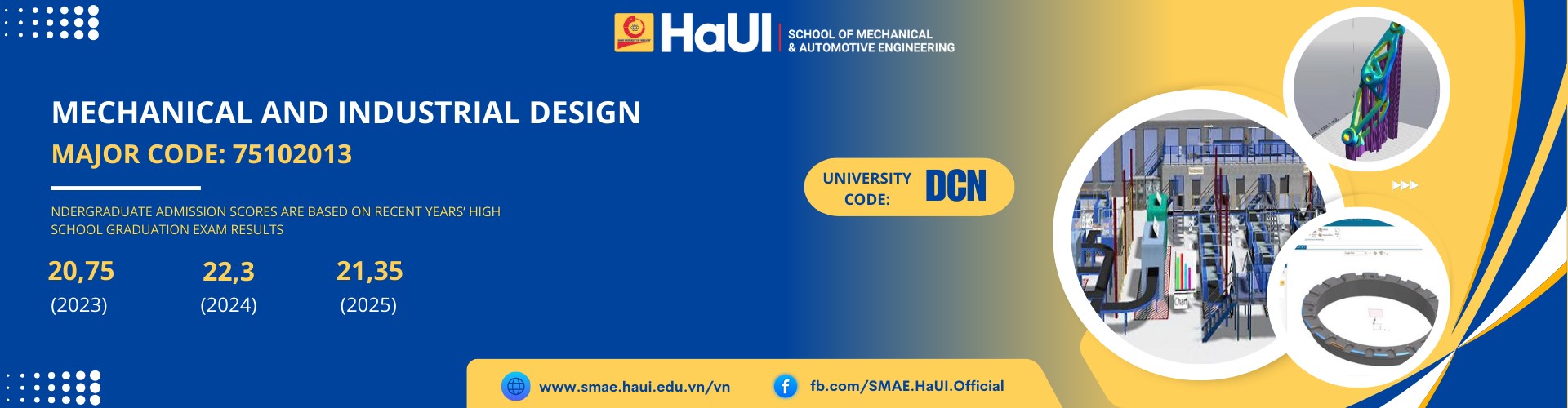
Mechanical and Industrial Design
1. General Objectives:
- To train high-quality human resources and conduct scientific and technological research to generate new knowledge and innovative products that meet the requirements of socio-economic development, ensure national defense and security, and promote international integration.
- To educate and train learners with sound political and ethical qualities; comprehensive professional knowledge and proficient practical skills; the ability to conduct research, develop, and apply science and technology; the capacity to work independently and creatively and solve problems in the field of Mechanical Engineering Technology; good health, a strong sense of professional responsibility, adaptability to working environments, and a commitment to serving the people.
2. Program Educational Objectives
PEO 1: Have knowledge in social science, political science and law to resolve common problems related to training major.
PEO 2: Have specialized knowledge to resolve problems related to Mechanical and Industrial Design field.
PEO 3: Have professional skill in analyzing, evaluating, solving specialized problems. Have the ability to work in groups and communicate efficiently in technical and non-technical environments.
PEO 4: Have a professional attitude and working style, as well as strong professional ethics and discipline.
3. Student Outcomes
| SO Code | Student Outcome | PEO 1 | PEO 2 | PEO 3 |
|---|---|---|---|---|
| SO 1 | Apply fundamental knowledge of science and technology in professional activities. | x | ||
| SO 2 | Communicate effectively in various working environments. | x | ||
| SO 3 | Participate effectively in professional teams as both a team member and a team leader. | x | ||
| SO 4 | Apply engineering knowledge, skills, and modern engineering tools to solve professional problems. | x | ||
| SO 5 | Design systems, components, and processes that meet specific requirements for engineering problems related to Mechanical Design and Industrial Design. | x | ||
| SO 6 | Conduct standardized tests, measurements, and experiments; analyze and interpret experimental results to improve processes. | x | ||
| SO 7 | Demonstrate the ability to engage in lifelong learning; recognize responsibilities towards the profession, the environment, and society; and possess fundamental knowledge of social sciences, politics, and law. | x |
4. Career opportunities after graduation:
After graduation, students can work in following fields:
- Design products (mechanical and electronics products, household products, automobile, motorbike…);
- Manage design; supervise and evaluate products;
- Research at institutes, Research and Development Department (R&D) of enterprises;
- Teach at universities, colleges…
5. Annual students enrollment and graduation statistics table
6. Curriculum Framework for Mechanical and Industrial Design
Copyright © 2022 School Of Mechanical And Automotive Engineering