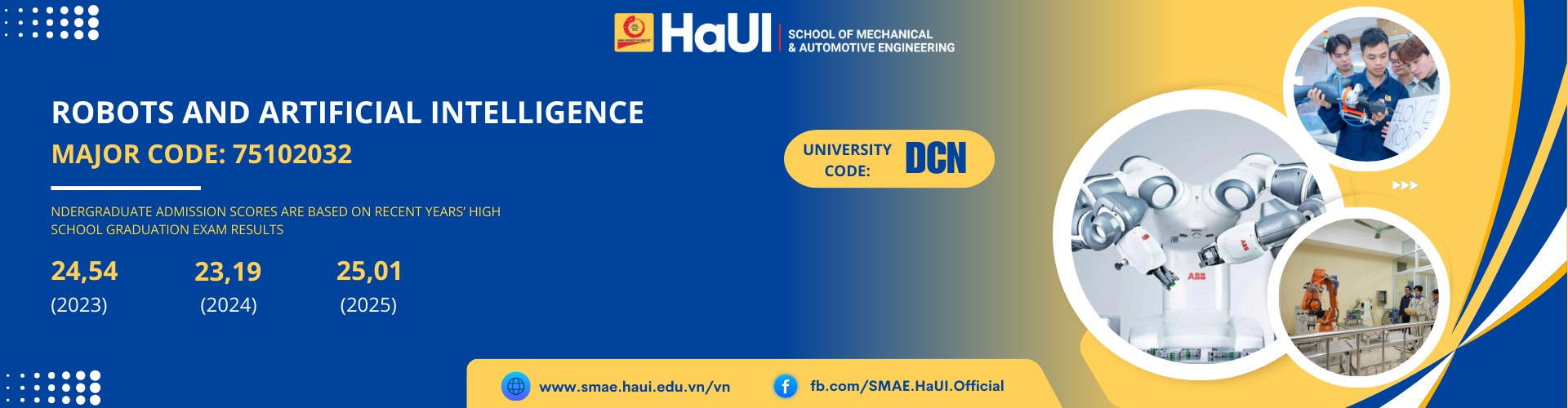
Robots and Artificial Intelligence
1. General Objective
To educate and train learners with solid professional knowledge and a fundamental understanding of science and technology; practical professional skills; the ability to apply knowledge and skills creatively; the capacity to work independently or in teams; and a strong sense of autonomy and responsibility in their professional activities, enabling them to solve problems related to the fields of Robotics and Artificial Intelligence in multidisciplinary and international environments.
2. Programme Educational Objectives (PEOs)
PEO 1: Ability to apply mathematical and natural science knowledge in the fields of Robotics and Artificial Intelligence.
PEO 2: Possession of fundamental and specialized knowledge in Robotics and Artificial Intelligence.
PEO 3: Ability to design, manufacture, and operate components of systems in the fields of Robotics and Artificial Intelligence.
PEO 4: Competence in research, development, and application of new scientific and technological advancements, as well as in solving problems within the field of Robotics and Artificial Intelligence.
PEO 5: Ability to work independently and collaboratively in teams to effectively solve multidisciplinary technological and engineering problems in global working environments; effective communication skills to establish and implement engineering solutions that meet practical needs.
PEO 6: Ability to engage in lifelong learning through professional development and pursue higher qualifications in Robotics or related fields; possession of sound political and professional ethical qualities; understanding of social sciences and humanities relevant to the field of study, enabling effective contributions to the sustainable development of society and communities.
3. Student Outcomes
| SO code | Student Outcome | PEO 1 | PEO 2 | PEO 3 | PEO 4 |
|---|---|---|---|---|---|
SO 1 | Apply fundamental knowledge of science and technology in professional activities. | X | X | ||
SO 2 | Communicate effectively in various working environments. | X | |||
SO 3 | Participate effectively in professional teams as both a team member and a team leader. | X | |||
SO 4 | Apply engineering knowledge, skills, and modern engineering tools to solve professional problems. | X | |||
SO 5 | Carry out design, operation, and maintenance processes for components and systems that meet requirements related to Robotics and Artificial Intelligence. | X | |||
SO 6 | Conduct standardized tests, measurements, and experiments; analyze and interpret experimental results to improve processes. | X | |||
SO 7 | Demonstrate the ability to engage in lifelong learning; recognize responsibilities towards the profession, the environment, and society; and possess fundamental awareness of social sciences, politics, and law. | X |
4. Career Opportunities after Graduation
The employment rate of graduates within one year of graduation reaches 95%. Graduates have opportunities to work for domestic and international corporations and enterprises, with typical monthly salaries ranging from VND 10 million to VND 30 million.
Potential Career Positions:
Graduates majoring in Robotics and Artificial Intelligence at universities can pursue various career positions, including Robotics Design Engineers, Manufacturing Engineers, Robotics Programmers, Artificial Intelligence Developers, and Researchers or Lecturers in Robotics and AI, among others.
- Operate, manage, and supervise the production of automated and semi-automated systems in factories of domestic and international enterprises and corporations related to Robotics and Artificial Intelligence.
- Troubleshoot and perform maintenance on production lines, equipment, and machinery in factories, enterprises, and companies.
- Conduct research, design, and develop manufacturing and production processes for intelligent automated products related to robotics, as well as develop new products and technologies.
- Receive, implement, and transfer new technologies in the fields of Robotics and Artificial Intelligence.
- Program, process, and analyze data for systems applying Robotics and Artificial Intelligence technologies.
- Teach and conduct research at research institutes, universities, and R&D departments of companies and enterprises that utilize intelligent systems.
- Provide technical consultancy and engage in the business of equipment and products related to Robotics and Artificial Intelligence.
5. Curriculum Framework for Robots and Artificial Intelligence
Copyright © 2022 School Of Mechanical And Automotive Engineering